
Basket backtesting simulates how a group of instruments would have traded together as one order set, weighted and rebalanced on rules, with execution costs applied at the trade level. Getting a trustworthy result means two things above all else: model transaction costs and slippage as if you actually had to fill many positions at once, and validate performance on data the strategy never saw during design. A platform like Trade-4 can help you configure both aspects without writing custom simulation code.
TL;DR:
- Trustworthy basket backtesting requires modeling transaction costs and slippage realistically for multiple instruments and validating results on unseen data.
- A basket involving dozens of names or index replication must account for cross-asset correlations and liquidity profiles, unlike single-asset tests.
- Key metrics include performance ratios, operational data such as turnover, and risk measures like correlations and concentration, to confirm realistic execution assumptions.
- High-quality data should be adjusted for corporate actions, checked for survivorship bias, aligned across sources, and cached to ensure reproducibility.
- Tools like Trade-4 simplify modeling intraday data, precise execution costs, and walk-forward validation for small-cap basket strategies without coding.
Table of Contents
- What Is Basket Backtesting and When Do You Need It?
- Key Metrics That Decide If a Basket Backtest Is Believable
- Data Requirements and Data Quality for Realistic Basket Tests
- How to Design and Run a Realistic Basket Backtest
- Validation, Robustness Checks, and Common Pitfalls
- Advanced Techniques and Algorithmic Considerations
- How a No-Code, Tick-Capable Backtester Handles the Hard Parts
- Basket Backtesting vs. Single-Asset Backtesting
- Software Tools and Platforms for Basket Backtesting
- Real-World Examples of Basket Backtesting in Action
- Diversification's Real Effect on Backtest Numbers
- Romans' Quick Checklist and Lessons From Practice
- Try Trade4: Next Steps and CTA
What Is Basket Backtesting and When Do You Need It?
A basket trade is an order that buys or sells multiple securities simultaneously to maintain portfolio weights or replicate an index, used by institutional desks for decades to move large positions with minimal market impact. Basket backtesting takes that same idea and tests it against history: instead of asking "would this one stock trade have worked," you ask "would this entire group of positions, rebalanced on schedule, have produced the returns and risk profile I expect."
You reach for basket backtesting, not single-asset backtesting, in a specific set of situations:
- Rebalancing strategies that hold dozens of names and periodically reset weights back to target
- Index or factor replication, where you're trying to mirror or beat a benchmark built from many components
- Multi-leg strategies like pairs trades, sector rotations, or long/short baskets that depend on relative moves between instruments
- Small-cap basket strategies where correlated gap and volume events across several tickers matter more than any single name's chart
The reason basket-level testing behaves differently comes down to synchronization and cross-asset correlation. A single-stock backtest only has to worry about that stock's own liquidity and price history. A basket has to handle 15 instruments trading at once, each with its own liquidity profile, its own gaps, and its own correlation to the others. Ignore that and your backtest will overstate what you could actually fill in real markets.
Key Metrics That Decide If a Basket Backtest Is Believable
Three categories of numbers separate a basket backtest you can trust from one that's quietly lying to you. Skip any one of them and you're flying with a blind spot.
Performance metrics tell you what the strategy earned and how bumpy the ride was:
- CAGR (compound annual growth rate) for the headline return
- Volatility and Sharpe or Sortino ratio to size that return against the risk taken
- Maximum drawdown, since a strategy that returns 15% a year but loses 40% at some point isn't the same product as one with a shallow drawdown
- Calmar ratio, which divides return by max drawdown and tends to expose baskets that look great on paper but would have been unbearable to hold
Operational metrics tell you whether the strategy is even executable. Turnover, total trade count, and average holding period all matter here, because a basket that rebalances weekly across 20 names racks up cost and slippage in a way a monthly rebalance never will.
Risk metrics round it out: correlation matrices between basket members, factor exposures (sector, size, momentum), and concentration measures showing whether three positions are quietly driving 60% of the basket's variance.
Pro Tip: Put turnover and trade count directly next to your Sharpe ratio in every report you generate. A Sharpe of 1.8 paired with 400% annual turnover is a very different strategy than the same Sharpe with 40% turnover, and the difference is almost entirely in unmodeled cost.
Data Requirements and Data Quality for Realistic Basket Tests
Your bar granularity decision shapes everything downstream. Daily bars are fine for a monthly-rebalance factor basket. They are not fine for a strategy that enters on an intraday gap or holds for minutes, where you need 1-minute or even 1-second data to capture the fills you'd actually get.
Data quality issues that silently wreck basket backtests include:
- Corporate actions and dividends. A stock split or special dividend that isn't adjusted correctly will produce a phantom gap in your basket's return series.
- Survivorship bias. If your universe only includes companies that still exist today, you've quietly excluded every basket member that went bankrupt or got delisted, which inflates historical returns.
- Series alignment. Five instruments with five different data vendors rarely share identical timestamps or trading calendars, so you need explicit alignment logic rather than assuming everything lines up.
- FX handling, if your basket spans currencies, since converting at the wrong rate on the wrong day introduces error that compounds across every rebalance.
Non-synchronous timestamps and differing liquidity across basket members are why a single global slippage number is usually the wrong model. A basket combining a large-cap ETF component with a thinly traded small-cap needs per-asset slippage parameters, not one blanket estimate applied to every leg.
Pro Tip: Cache your raw data and version it before you touch it. When a result looks too good, the first thing worth checking is whether the dataset changed between your last two test runs, and you can't check that if you overwrote the original file.
Reproducibility matters just as much as accuracy. If you can't rerun the exact same basket test six months from now and get the same numbers, you don't have a backtest, you have a one-time simulation. For a deeper walk-through of clean, repeatable data handling, see Trade4's guide to tick data backtesting.
How to Design and Run a Realistic Basket Backtest
Building a basket backtest that holds up under scrutiny follows a fairly consistent sequence. Skipping steps is how traders end up with backtests that look great and trade badly.
- State your hypothesis and pick a benchmark. Write down exactly what edge you're testing (a gap-fade across small caps, a sector-rotation basket, an index-replication sleeve) and choose the index or portfolio you're measuring against.
- Select instruments and a weighting scheme. Equal weight is the simplest baseline, but volatility weighting, market-cap weighting, or factor-tilted weighting each change the risk profile substantially, so test more than one scheme.
- Set rebalancing rules and cash-management behavior. Decide the frequency (daily, weekly, on-signal) and what happens to cash between rebalances, since letting cash sit idle versus sweeping it into a money-market proxy changes your return figures.
- Specify the execution model. This is where most basket backtests fall apart. Build in commission tiers, a per-side slippage estimate as a starting illustrative value, and order slicing logic for larger positions that can't fill in one clip.
- Run in-sample first, then rolling out-of-sample. Fit or tune parameters on one period, then test on a period the strategy never touched during design, and repeat that roll forward through time rather than testing once and calling it done.
- Keep full trade logs. Every fill, every slippage assumption, every rebalance event should be logged at the trade level so you can audit exactly why the equity curve moved the way it did.
Things to check off before you trust the output:
- Does the execution model apply different slippage to your least liquid basket member versus your most liquid?
- Did you test at least two rebalancing frequencies to see how sensitive returns are to that choice?
- Can you regenerate the identical result from the same data snapshot?
Validation, Robustness Checks, and Common Pitfalls
Walk-forward testing is the standard way professional quants separate a real edge from a lucky curve fit. You optimize parameters on a rolling window, test on the next unseen window, then slide forward and repeat. If performance holds up reasonably consistently across those out-of-sample windows, you have something. If it only worked in the window you tuned on, you've built an expensive coincidence.
Multiple-testing concerns grow with basket complexity. Test 200 weighting and rebalancing combinations and a handful will show a strong Sharpe ratio purely by chance. The Deflated Sharpe Ratio approach corrects for this by discounting your best result based on how many variations you actually tried, which matters more for baskets than single instruments because there are simply more parameters to sweep (weights, rebalance timing, entry filters per leg).
Run sensitivity analysis on three levers before trusting a result:
- Transaction costs, doubled and halved, to see how much of your edge is cost-dependent
- Rebalancing frequency, shifted a notch in either direction
- Any threshold parameter (gap %, volume filter) nudged slightly
Pro Tip: If a basket strategy's Sharpe ratio collapses when you double your slippage assumption, that strategy was never robust. It was living on an execution-cost assumption you got lucky with.
Basket-specific execution pitfalls deserve extra attention. Fragmentation across venues, where different basket members trade on different exchanges with different liquidity depth, and venue limits that cap how much size you can move without moving the price, both cause backtests to look better than live execution ever will.
Advanced Techniques and Algorithmic Considerations
Cointegration-based weighting earns its place when you're building mean-reversion baskets, pairs, or spread trades where the statistical relationship between instruments, not their individual trends, is the source of edge. Bayesian or global optimization methods can search weight combinations more efficiently than brute-force grids, though they carry a higher overfitting risk if you don't pair them with the walk-forward and Deflated Sharpe checks already covered.
Open-source frameworks illustrate what a mature basket-testing pipeline looks like in practice. Python libraries such as cvxportfolio build around a market-simulator abstraction that supports parallelized backtest runs and pulls from public sources like Yahoo Finance or FRED, while community projects on GitHub implement walk-forward analysis and per-trade logging as defaults rather than afterthoughts. Parallelizing large parameter sweeps and caching intermediate results isn't a luxury at this scale, it's what keeps a multi-day optimization run from becoming unreproducible. Tick or 1-second data and same-day re-entry modeling become necessary once your basket includes intraday small-cap gap or momentum legs, where the difference between a 1-minute bar and a 1-second bar can be the difference between a real fill and a fantasy one.
How a No-Code, Tick-Capable Backtester Handles the Hard Parts
Everything above, execution modeling, tick-level data, walk-forward validation, gets harder to build from scratch than most traders expect. Trade-4 was built specifically to close that gap for small-cap traders without requiring you to write a market simulator in Python.
- Tick-accurate historical data down to 1-second bars for basket legs where minute bars hide the real fill
- Same-day re-entry analytics to see how a basket behaves when a position gets stopped and retriggered within the same session
- News tagging so you can separate basket performance during news-driven gaps from quiet-market behavior
- Configurable execution-cost settings so slippage and commission assumptions match your actual broker, not a generic default
You can build a basket setup visually, apply it across your instrument list, and get bucketed performance reports without managing a local database. Start with Trade4's step-by-step backtesting walkthrough if you want to see the workflow before committing to a full setup.
Basket Backtesting vs. Single-Asset Backtesting
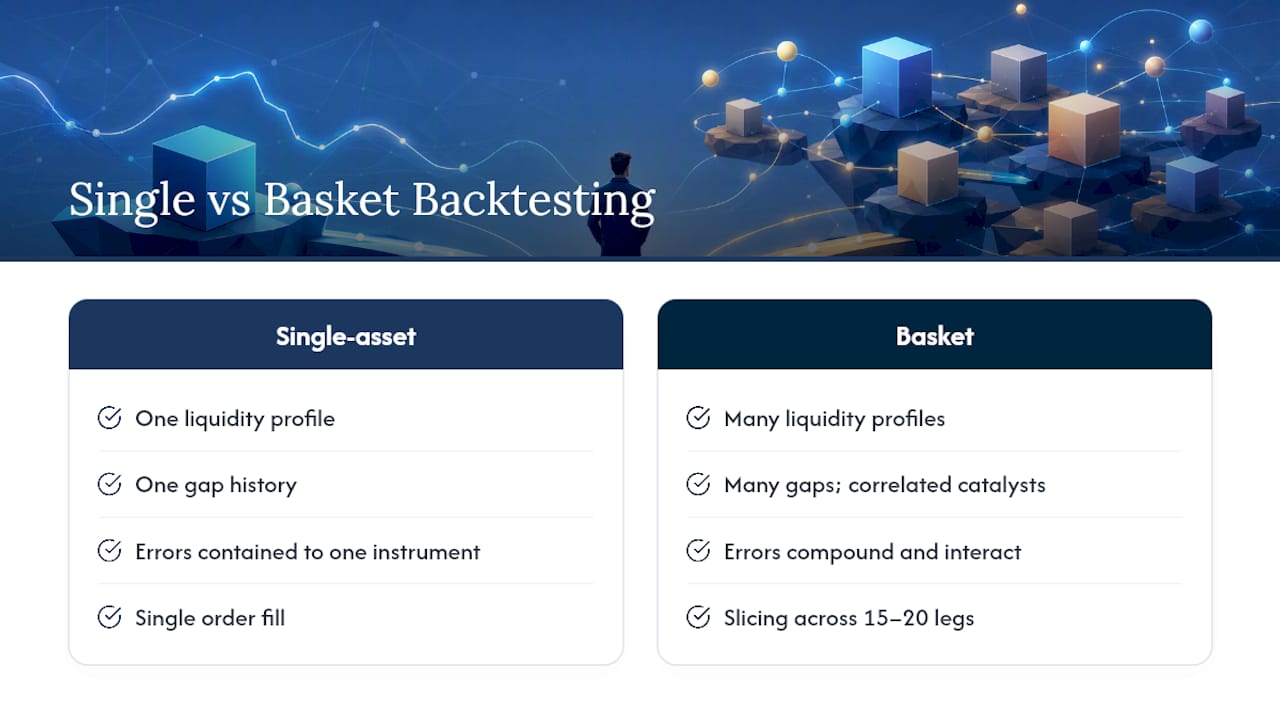
The core difference isn't complexity for its own sake, it's what can go wrong. A single-asset backtest has one liquidity profile, one gap history, one execution path to model. Get the slippage assumption slightly wrong and your error is contained to that one instrument's numbers.
A basket multiplies every one of those assumptions by however many instruments you're holding, and the errors don't just add up, they interact. If your basket's small-cap members gap on the same catalyst day (an earnings season, a sector-wide news event), your correlation assumption is doing far more work than it would in a single-name test, and getting it wrong compounds across every position simultaneously.
Single-asset backtests also let you get away with a simpler execution model most of the time, since you're filling one order rather than slicing size across 15 or 20 legs that may trade on different venues with different depth. Basket tests demand you think about portfolio-level cash constraints too: what happens when three basket members trigger entry signals on the same day and you don't have capital for all three at full size? A single-asset test never has to answer that question. A basket test has to answer it every single day it runs.
The payoff for handling this correctly is a result that actually reflects how a real portfolio would have behaved, not how one lucky stock happened to move.
Software Tools and Platforms for Basket Backtesting
Several categories of tools handle basket-level testing, and which one fits depends on how much code you're willing to write and how granular your data needs to be.
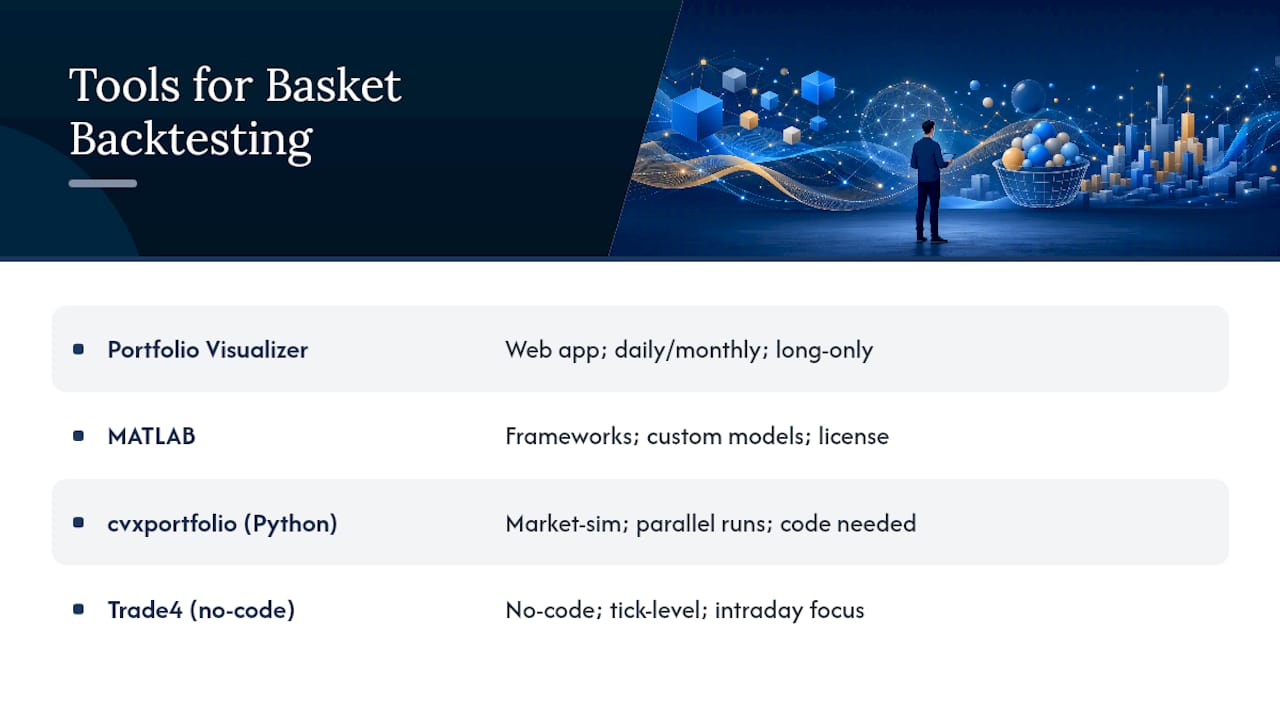
Portfolio Visualizer offers free web-based portfolio construction from ETFs, mutual funds, and stocks, letting you configure time period, cashflows, and rebalancing frequency to generate performance summaries, trailing returns, and allocation breakdowns. It's a strong starting point for long-only, buy-and-hold-style basket testing at daily or monthly resolution, though it isn't built for intraday execution modeling.
MATLAB's backtesting frameworks give quant teams and serious individual researchers documented tools for strategy validation and risk-model backtesting, with enough flexibility to build custom cost models and factor exposures. The tradeoff is a real coding investment and a MATLAB license.
cvxportfolio and comparable open-source Python libraries give you a market-simulator abstraction, parallelized runs, and direct access to public data sources, appealing if you're comfortable writing and maintaining code and want full control over the optimization layer.
Trade4 occupies a different spot on that spectrum: a no-code, visual pattern builder for small-cap traders who need tick-level (down to 1-second) historical data, granular entry and exit filters, and same-day re-entry analytics, without maintaining a local database or writing simulation code. For traders whose edge lives in intraday small-cap gap and volume behavior rather than long-horizon factor allocation, that combination matters more than raw scripting flexibility.
Real-World Examples of Basket Backtesting in Action
Index replication is the clearest institutional example. A fund tracking a small-cap index doesn't buy one stock, it buys a basket of hundreds, rebalanced quarterly to match index weight changes, and the backtest has to model the market impact of trading all of them near the rebalance date simultaneously, since everyone tracking that index is trading at the same time.
Sector-rotation baskets show a different pattern. A strategy that holds the top five momentum names in a sector and rotates monthly will backtest very differently depending on whether you model slippage per-name or apply one blanket slippage assumption across the basket. Traders who ran that comparison typically find the blanket assumption overstates returns, sometimes substantially, because it ignores that the least liquid name in the basket is usually the one driving most of the momentum signal.
Small-cap gap baskets, common among Trade-4's user base, illustrate the fragmentation risk directly. A basket of five small-cap tickers that all gap up on a sector catalyst looks like five independent opportunities in a naive backtest. In reality, they're correlated bets on the same news event, and a realistic basket test needs to size positions accordingly rather than treating each leg as statistically independent.
Diversification's Real Effect on Backtest Numbers
Diversification tends to smooth the equity curve in ways that flatter your Sharpe ratio, which is exactly why you have to check whether that smoothing is real or an artifact of your correlation assumptions. A basket of 20 loosely correlated names will show lower volatility than any single member, and that's a genuine effect, not a backtesting error.
The distortion creeps in when your historical correlation estimates don't hold during stress periods. Small-cap baskets in particular tend to show low correlation in calm markets and much higher correlation during selloffs, when everything gaps down together regardless of sector or catalyst. A backtest built on calm-period correlation data will understate drawdown risk exactly when it matters most.
Turnover and cost also scale with basket size in a way that's easy to underweight mentally. Adding a 21st position to smooth the equity curve further sounds appealing until you account for the extra commissions, the extra slippage, and the extra data cleaning burden that position adds. Beyond a certain point, each additional basket member contributes shrinking diversification benefit against a roughly constant cost increment, and a well-run backtest should show you exactly where that crossover happens rather than assuming more names always means better.
Romans' Quick Checklist and Lessons From Practice
Every basket backtest I'd trust clears the same short list: real per-asset slippage, not a blanket number; corporate-action-adjusted data with survivorship bias checked; a rolling out-of-sample window, not one held-out chunk; and full trade-level logs you can actually audit later.
The pragmatic shortcut worth taking is starting with a coarser bar granularity to sanity-check the hypothesis, then dropping to tick or 1-second data only once the concept survives that first pass. Building the expensive execution model before you know if the idea has any edge at all wastes real time.
— Romans
Try Trade4: Next Steps and CTA
Everything covered here, tick-level data, per-asset slippage, same-day re-entry, walk-forward validation, is exactly what Trade-4 was built to make configurable without a single line of code. Where a Python library like cvxportfolio demands you build your own market simulator, and Portfolio Visualizer caps out at daily-resolution reporting, Trade-4 gives small-cap traders a visual pattern builder tied directly to 1-second historical data and granular execution-cost settings.
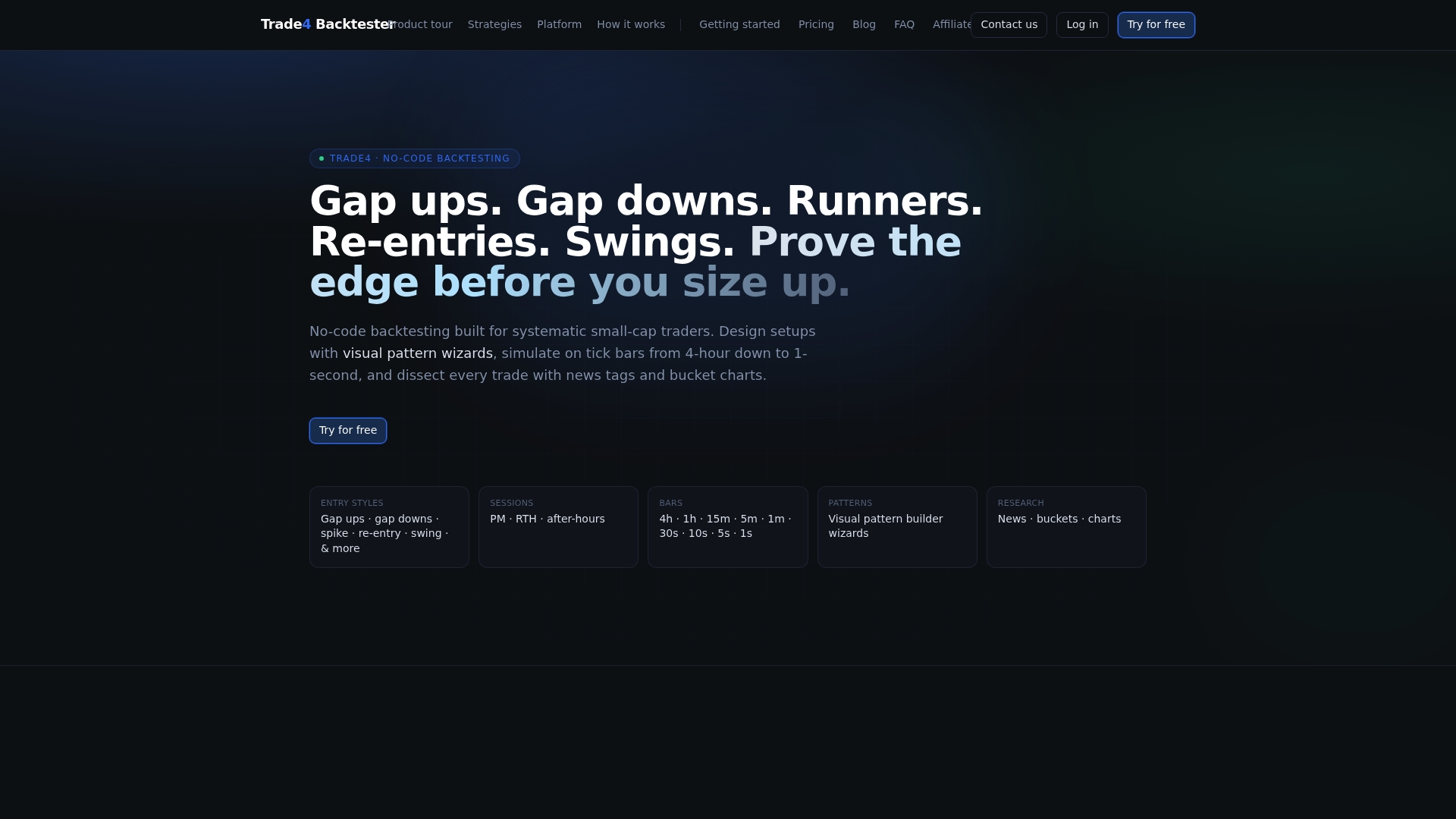
You can configure a basket setup, apply news tagging to separate catalyst-driven moves from noise, and pull bucketed performance reports without managing a local database. Start with the Trade4 getting-started guide to walk through your first basket setup, check the pricing page to find the plan that matches your data-history needs, or head straight to the Trade4 Backtester product page to see the full feature set before you commit to a plan.
This article is general information, not a substitute for advice from a qualified financial advisor. Consult a qualified financial professional about your own circumstances before acting on anything here.