
Look-ahead bias is a time-order violation: your simulation uses information that would not have existed yet at the moment it made a decision, and that leak quietly inflates every performance number downstream. The fastest way to check your own work is the one-bar shift test. Push every fill one bar later and rerun the backtest. If performance collapses instead of decaying gently, you have a leak.
Watch for these red flags before you trust a single equity curve:
- An annualized Sharpe ratio that may be unrealistically high for the strategy's simplicity
- An equity curve that climbs in an almost perfectly smooth line with no rough patches
- A trade list you cannot reproduce exactly on a second run
Statistic to remember: controlled simulations show a single same-bar execution error can push an annualized Sharpe from around −0.74 (no real edge) to a very high positive level, entirely from noise.
Key Takeaways
A trustworthy backtest is one whose edge survives a one-bar shift, a timestamp audit, and a perturbation test without collapsing.
| Point | Details |
|---|---|
| Run the shift test first | Delay every fill by one bar; collapse instead of decay signals leakage. |
| Audit timestamps directly | Assert feature_time ≤ decision_time on every row of your pipeline. |
| Use point-in-time data | Lag quarterly fundamentals by a conservative delay of several weeks to a few months and annuals by a longer delay when vintage data is unavailable. |
| Compare trade lists, not just stats | Two runs with similar Sharpe ratios can still disagree on which trades fired. |
| Validate with Trade-4 | Trade-4's tick-level backtester and reproducible trade galleries support this diagnostic-first workflow. |
Authoritative Sources and Tool Docs to Follow Up On
- Academic and SSRN research quantifying lookahead-driven return inflation in factor models
- Practitioner write-ups measuring the same-bar fill's effect on simulated Sharpe ratios
- Freqtrade's lookahead-analysis documentation, a working example of automated leak detection
Table of Contents
- What Lookahead Bias Is and Why It Wrecks Backtest Reliability
- Step-by-Step Diagnostics: The Prioritized Tests to Detect Lookahead Bias
- How to Remove Leaks and Harden Your Backtests
- Point-in-Time Data and Reporting Lag Recommendations
- Applied Validation Workflow and Platform Alignment
- Why Most Quants Underestimate How Small a Leak Can Be
- Validate Your Strategy Before You Risk Real Capital
What Lookahead Bias Is and Why It Wrecks Backtest Reliability
Lookahead bias happens whenever a backtest's decision engine sees data timestamped after the moment it is supposed to be acting. That is a causality violation, not just an accounting slip, and it does not need to be dramatic to do damage. A signal computed with today's closing price but executed at today's open, a fundamental ratio pulled from a value that got revised three months later, a normalization step that scales the whole series using data from years in the future. Each one hands your strategy a peek at the answer key.
The scary part is how small the error can be and how large the payoff looks. Academic work on factor models shows overlapping training and test windows quietly inflate returns even when researchers believe they separated the two properly.
Lookahead bias is not the same problem as overfitting or survivorship bias, though all three get lumped together:
- Overfitting tunes too many parameters to noise in a fixed, honest dataset.
- Survivorship bias tests only on assets that still exist today.
- Lookahead bias feeds the model information from the wrong point in time entirely.
Step-by-Step Diagnostics: The Prioritized Tests to Detect Lookahead Bias
Run these in order. Each test either confirms a leak, rules one out, or tells you how big it is.
- One-bar shift test. Delay every execution by one bar and rerun the full backtest. A genuine edge decays modestly; a leaked one collapses toward zero or flips negative.
- Timestamp assertion. Add a hard check that
feature_timeis always less than or equal todecision_timeat every row. This one line of code catches a surprising share of leaks instantly. - Manual replay audit. Walk through a handful of trades bar by bar and confirm the exact data your model saw at the moment it decided, not what your dataframe shows you now.
- Perturbation/noise test. Replace everything after the decision point with random noise and confirm your model's choices do not change. If they do, something downstream is influencing the decision.
- Compare full trade lists, not just summary stats. Two runs can share a similar Sharpe while disagreeing on which trades actually fired, which is itself a leak signature.
- Walk-forward validation with frozen parameters. Lock your parameter set before running any diagnostic. Tuning after the fact can mask a leak as "just a different config."
Pro Tip: Freeze your strategy's parameters before you run a single diagnostic. If you keep adjusting settings while hunting for leaks, you will not be able to tell whether a fix worked or whether you just got lucky with a new configuration.
How to Remove Leaks and Harden Your Backtests
Detection only gets you halfway. Fixing the pipeline is what makes the results trustworthy going forward.
- Use point-in-time (vintage) data for anything that is not raw price, or apply a conservative reporting lag when vintage data is not available.
- Make every indicator causal. Rolling or expanding windows only, never centered or zero-phase filters like
filtfilt. - Rebuild your historical universe to include names that were delisted, acquired, or dropped, and close those positions at their last traded price instead of erasing them from history.
- Enforce timestamped joins on every data merge, and log the exact data snapshot each backtest run used so you can reproduce the trade list later.
- Freeze parameters, record a baseline diagnostic run, then iterate one change at a time so you know which fix actually mattered.
Pro Tip: Treat your trade log the way an auditor would. If you cannot regenerate the same fills, prices, and timestamps from a fresh run, you do not have a backtest, you have a story. Trade-4's step-by-step backtest workflow walks through building this kind of reproducible pipeline from scratch.
Point-in-Time Data and Reporting Lag Recommendations
Price data is usually clean and reliably time-stamped, so a strategy trading purely off OHLCV bars rarely needs an extra lag. Fundamentals, index membership, and analyst estimates are a different story. Those numbers get revised, restated, and reclassified well after their original reporting date, so using the "current" value in a historical backtest almost always leaks.
When true point-in-time data is not available, practitioner guidance suggests these starting ranges:
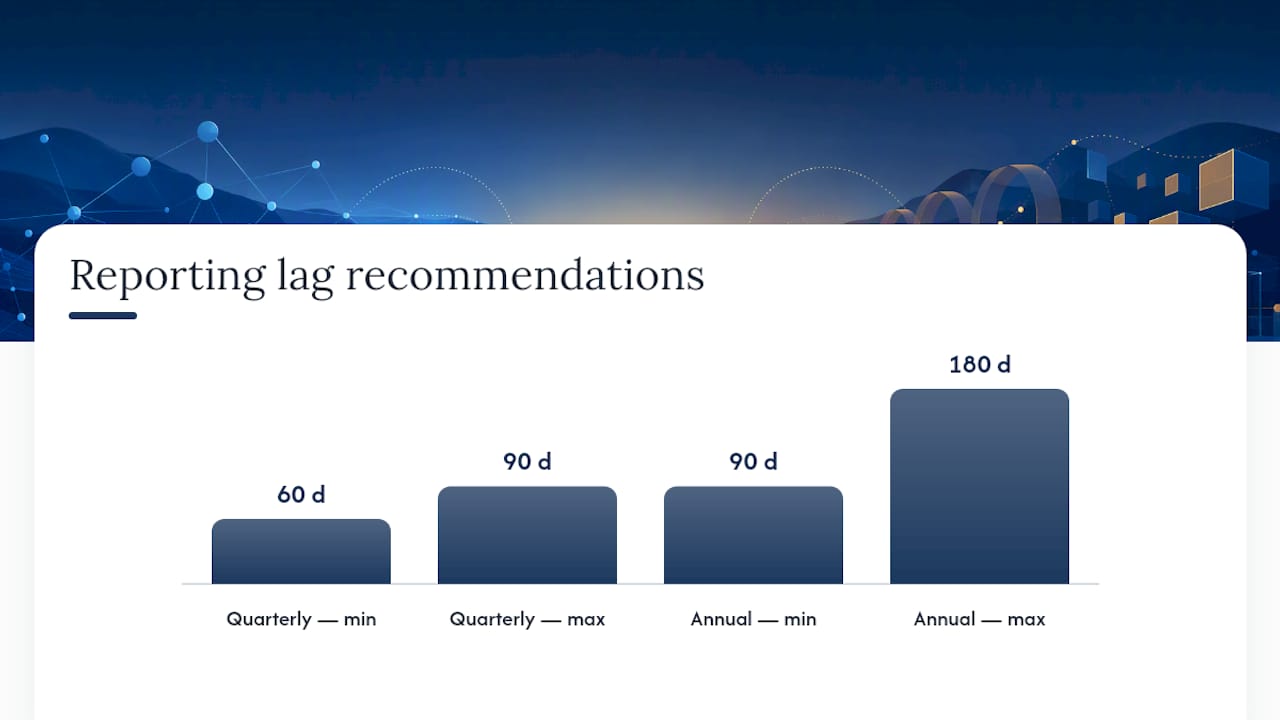
- Quarterly fundamentals: lag by roughly 60 to 90 days.
- Annual reports: lag by roughly 90 to 180 days.
- Index membership and corporate actions: apply the announcement date, not the effective date, and rebuild historical constituent lists rather than using today's.
Treat the lag itself as a parameter. Test a range of lag values and check whether your results are sensitive to the exact number, because a strategy that only works with a suspiciously short lag is telling you something.
Statistic to remember: these lag ranges (60 to 90 days for quarterlies, 90 to 180 for annuals) come directly from practitioner guidance built around real reporting delays, not arbitrary buffers.
Applied Validation Workflow and Platform Alignment
A repeatable validation loop looks like this: freeze your research and parameters, run the one-bar shift and perturbation tests, then confirm with a walk-forward replay before you trust the numbers.
- Freeze parameters and log the baseline run.
- Run the one-bar shift test and compare performance metrics against the baseline to detect anomalies.
- Run a perturbation test on post-decision data.
- Replay a sample of trades manually against timestamped inputs.
- Confirm with walk-forward validation using out-of-sample windows.
Trade-4's no-code backtesting platform was built for small-cap traders who need this level of scrutiny without writing their own execution engine. It runs historical data tests down to one-second granularity, with news tagging, granular performance metrics, and same-day re-entry analytics built in, so you can size up a strategy's real edge instead of a leaked one.
A backtest that cannot survive a one-bar shift was never measuring an edge. It was measuring a mistake.
Why Most Quants Underestimate How Small a Leak Can Be
The conventional wisdom treats lookahead bias like a binary bug: either your code peeks at the future or it doesn't. That framing misses the real danger. A fraction-of-a-bar timing error can inflate performance almost as badly as a full-bar leak, which means the usual gut check ("I don't use future data, so I'm fine") isn't enough.

Most traders also over-invest in cross-validation and under-invest in causality checks. Cross-validation assumes your data was collected honestly in the first place. If the same leak sits in every fold, splitting the data ten different ways just gives you ten confirmations of the same lie. That is why the one-bar shift test deserves to be step one, not a footnote: it tests the thing cross-validation cannot see.
If you take one thing from this, prioritize reproducibility over sophistication. A strategy whose trade list you can regenerate exactly, bar by bar, timestamp by timestamp, is worth more than one with a fancier model and a Sharpe you can't explain.
— Romans
Validate Your Strategy Before You Risk Real Capital
Manual audits catch leaks eventually, but rebuilding point-in-time universes and timestamp-checking every join by hand eats hours you could spend testing more setups. Trade-4 gives small-cap traders a no-code way to run that same diagnostic discipline, tick-accurate data down to one second, visual pattern builders, and reproducible trade galleries that let you replay any run and confirm exactly what your strategy saw and when.
If your equity curve looks too smooth to be true, that's usually because it is. Same-day re-entry analytics and bucketed performance breakdowns help you see whether your edge holds up across different market conditions instead of one lucky stretch of history. Start a trial and run your first shift-test comparison directly inside the Trade4 Backtester to see whether your current strategy survives contact with a causal, leak-free simulation.