
For a backtest to be credible, every entry, exit, and sizing rule must be written so an engine can execute it without human interpretation. That means unambiguous logic, realistic fill and cost assumptions, and validation on data the rule never saw during development. Techniques like walk-forward testing, point-in-time data, and platforms like Trade4 exist precisely because vague rules and lookahead bias produce backtests that look great and fail in live trading.
TL;DR:
- Exact entry and exit rules must be fully specified with fixed parameters, avoiding vague terms that lead to inconsistent backtesting results.
- Proper validation involves out-of-sample testing, walk-forward analysis, Monte Carlo resampling, and thorough documentation to ensure the strategy is robust and not overfit.
- Realistic assumptions about fill models, transaction costs, timing, and re-entry windows are crucial for the backtest to reflect live trading conditions accurately.
- Common mistakes include ambiguous signaling, unclear re-entry rules, and neglecting news or overnight gaps, which can significantly distort backtest credibility.
- Using visual, rule-based platforms like Trade4 helps enforce discipline, test timing assumptions, and automate validation, reducing errors tied to manual coding or vague specifications.
Table of Contents
- What Does It Mean to Backtest Entry and Exit Rules?
- How Do You Define Exact Entry and Exit Rules?
- What Are the Most Common Entry Rule Types?
- What Are the Best Exit Rule Types for Trade Management?
- How Do You Implement Entry and Exit Rules in a Backtest?
- How Do You Validate That a Strategy Is Robust, Not Overfit?
- What Metrics Belong in a Backtest Report?
- What Recurring Mistakes Do Backtesters Make?
- Turn Your Rules Into a Tested Strategy With Trade4
- Selected Sources on Backtesting Methods and Exit Discipline
What Does It Mean to Backtest Entry and Exit Rules?
Backtesting entry and exit rules means simulating a strategy's exact decision logic against historical price data to see how it would have performed, trade by trade. The word "exact" carries the weight here. A rule like "buy on a breakout" isn't a rule yet. It's a sentence fragment waiting for the ambiguity to be removed.
Rule-based trading backtesting differs from casual chart review because it forces every judgment call into code before a single trade gets counted. That discipline is also what separates a useful backtest from a curve-fit fantasy. A rigorous backtest requires point-in-time data, realistic transaction costs, defined position sizing, an out-of-sample period the rules never touched, and entry/exit logic specific enough that two different programmers coding the same rule would produce identical trade lists.
Most traders who backtest and lose money in live markets didn't fail because their idea was bad. They failed because the rule they tested wasn't the rule they traded. Closing that gap is the entire game.
How Do You Define Exact Entry and Exit Rules?
A specification is only useful if it removes every decision from the trader's hands at execution time. Before a rule goes into any backtesting engine, run it through a checklist that forces precision on every variable that could otherwise be interpreted loosely.
- Instrument universe: define exactly which symbols qualify (market cap range, exchange, minimum average volume) and how the list gets rebuilt over time.
- Timeframe and price field: specify the bar interval (1-minute, 1-second, daily) and whether logic reads the open, high, low, close, or a volume-weighted price.
- Conditional logic: write the trigger as a formula, not a description. "Enter when price breaks the 20-bar high" becomes
Close[t] > Max(High[t-20:t-1]). - Tie-breakers for intrabar events: decide what happens when a stop and a target could both trigger on the same bar, and pick one resolution order in advance.
- Order type and timing: state whether the entry fires at the close of the signal bar or the open of the next bar, and whether it's a market or limit order.
- Position sizing: define the formula (fixed dollar risk, percent of equity, fixed shares) with no discretion left to "feel."
- Stop and target math: write the exact price formula, not a percentage range you might round.
- Re-entry windows: specify whether the strategy can re-enter the same symbol same-day, and under what cooldown condition.
Vague rules produce inconsistent backtests even when two people believe they're testing the same idea. "Buy near support" tested by one coder might mean within 1% of a 50-day low; tested by another, it might mean a hand-drawn trendline. Those two backtests will never agree, and neither will match live results.
Separate the idea from the parameters you're tuning, and log every variant you test, including the ones that failed. That log becomes your defense against unconscious data-mining and the single locked specification you eventually trade.

What Are the Most Common Entry Rule Types?
Entry logic falls into a handful of recurring families. Each one needs its own layer of precision to become testable rather than descriptive.
- Breakout entries. Define the lookback window explicitly, such as a 20-bar high, and state whether the trigger fires on a close above that level or requires confirmation on the next bar's open. Add a size limit rule (minimum average dollar volume, for example) so the backtest doesn't fill illiquid names at prices that were never really available.
- Indicator crossover entries. A moving-average cross needs a stated lookback for both lines, the price field feeding the calculation (typically close), and a policy for what counts as "crossed": current bar close above the average, or two consecutive closes to filter noise. Smoothing parameters (simple vs. exponential) must be fixed, not left as a range.
- Pattern and template entries. Gap-and-go setups need the gap size threshold spelled out as a percentage of the prior close, the exact pre-market volume or price criteria used to screen candidates, and same-day constraints like a maximum number of entries per symbol. This is the category where small-cap traders lose the most precision, because "a strong gapper" means something different to every trader until it's written as a number.
- Volatility and regime filters, plus time-of-day windows. If a rule only applies when ATR is above a threshold or only during the first 30 minutes of the session, state the data source for that filter and the order in which dependencies get checked. A filter that depends on a VIX reading needs a stated policy for what happens when that data point is stale or missing.
Each entry type above can be coded as a signal array once every threshold, lookback, and timing choice is pinned down. Precision at this stage is what determines whether a backtest reflects a strategy or a coincidence.
What Are the Best Exit Rule Types for Trade Management?
Exit planning is usually the weaker half of a trading plan, even though well-specified stops and scaling rules often do more for account survival than clever entries ever will. Every exit method below needs the same level of mechanical precision as entries.
- Fixed targets and stops. Write the exact placement formula (entry price plus 2x ATR for a target, entry price minus 1x ATR for a stop) and decide how partial fills get treated if the order can't fill in full at that price.
- Trailing stops. Specify whether the trail is ATR-based or tracks the highest close since entry, and how often it updates. A trailing stop that recalculates every bar behaves very differently from one that updates once per session.
- Time exits and session closes. State the exact timestamp policy: does the position close at the literal session close, or at a specific minute before it? Define what happens if a gap occurs overnight and the stop level from the prior session no longer makes sense against the new open.
- Scaling out. If a strategy takes partial profits at multiple levels, code each tranche size and its trigger separately, and specify how the remaining position's stop moves after the first scale-out.
- Re-entry and forbidden windows. Same-day re-entry after a stop-out needs an explicit cooldown rule, or the backtest will happily re-enter a losing pattern five times in one session and skew your win rate.
The exception that swallows most exit plans is the news shock. Decide in advance whether a rule halts trading around scheduled catalysts (earnings, macro releases) or simply lets the stop absorb the move. Leaving that decision undefined means your backtest and your live trading will diverge exactly when it matters most.
How Do You Implement Entry and Exit Rules in a Backtest?
Turning a written rule into engine output means encoding signals, choosing a fill model, and pricing in the frictions that erode paper profits. Engine-friendly implementations typically use a discrete signal convention: 1 means enter or hold, 0 means no change, and negative 1 means exit. That three-state system avoids the ambiguous intrabar decisions that creep in when logic is written as free-form conditionals scattered across a script.
Timing conventions matter as much as the signal itself. A next-bar execution rule (signal generates on bar close, order fills on the following bar's open) is more realistic than assuming a fill at the exact price that triggered the signal, because no trader can act on a close before it happens.
Fill models need their own layer of realism. Market orders, limit orders, and stop orders each behave differently under a backtesting engine, and platforms built for this, including tools like backtrader, model partial fills, slippage distributions, and order queue assumptions separately for intraday tick-sensitive tests. Commissions, spread costs, and any borrow or financing fees on short positions all belong in the model too, and every cost assumption should get a sensitivity test across a realistic range rather than a single guess.
- Signal encoding: use 1/0/-1 conventions and declare any external data dependencies (a VIX filter, sector data) explicitly so the engine can forward-fill them deterministically.
- Fill assumptions: state market vs. limit vs. stop handling and a slippage distribution, not a flat number.
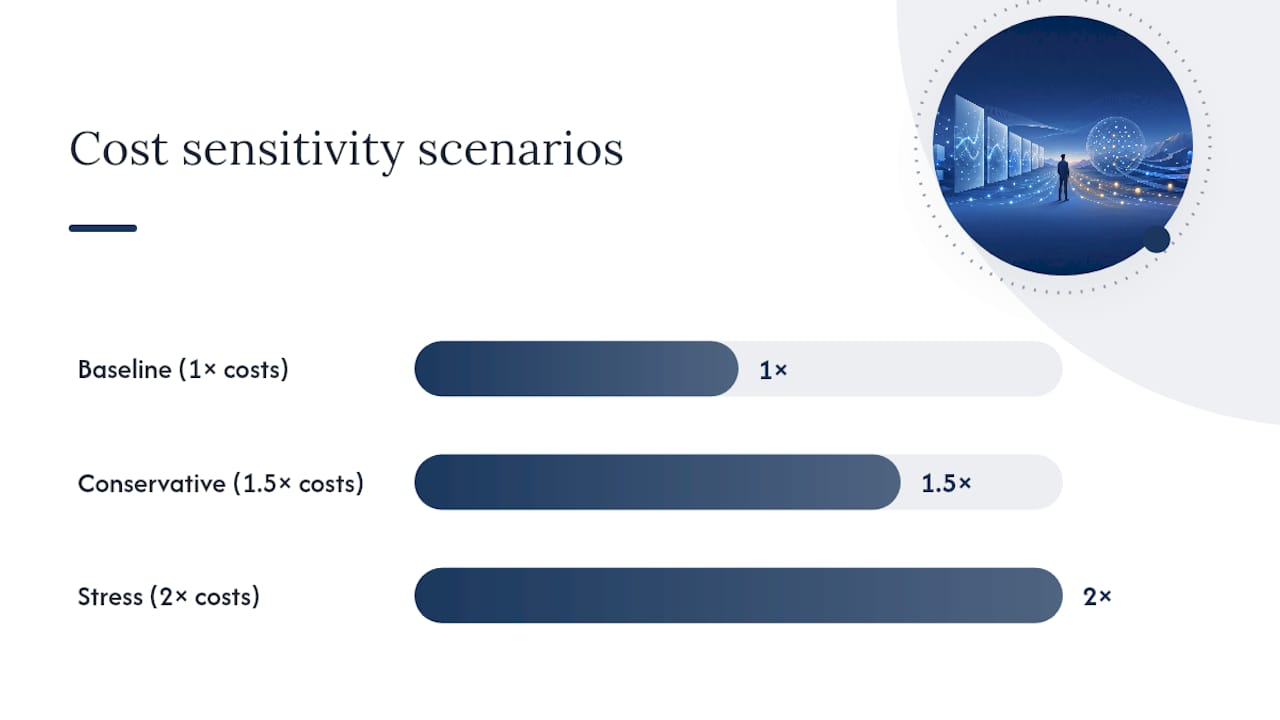
- Cost sensitivity: rerun the same rule set at 1.5x and 2x your baseline commission and spread assumptions to see how fragile the edge really is.
- Data hygiene: use point-in-time data that accounts for delisted tickers and historical index membership, and confirm every timestamp aligns to the correct exchange timezone and market hours.
Pro Tip: Run your exact rule set through a fast, vectorized engine at two or three cost scenarios before you trust a single equity curve. Vectorized frameworks that operate on array data can sweep a hundred cost combinations in the time it takes to review one chart.
How Do You Validate That a Strategy Is Robust, Not Overfit?
A backtest that only runs once on a single historical window tells you almost nothing about whether the edge is real. Validation is where most amateur backtests quietly fall apart, because the rules were shaped by the very data used to test them.
- Check for lookahead and survivorship bias first. Confirm no calculation uses information that wouldn't have existed at decision time, and confirm your universe includes delisted or acquired small-cap names rather than only survivors.
- Run a walk-forward or rolling validation. Split history into sequential in-sample and out-of-sample windows, optimize only on the in-sample chunk, then test unchanged on the next window forward. A pass means performance holds up reasonably across multiple forward windows; a fail means the edge only existed in the window it was tuned on.
- Apply Monte Carlo resampling. Shuffle trade order and resample outcomes to see how much the equity curve's shape depends on lucky sequencing rather than genuine edge. Engines that report an MC Score alongside a walk-forward verdict give you a single, standardized way to judge whether a strategy's statistics were a fluke.
- Sweep nearby parameters, not just the winning one. If a 20-bar lookback tests brilliantly but a 19-bar or 21-bar lookback collapses, that's a red flag for overfitting, not a discovery.
- Document every variant tested and cap the count. The more parameter combinations you try, the more likely one looks good by chance alone. An honest log of what you tested is your best defense against fooling yourself.
No strategy performs identically across every market regime, and validation has to include the ugly stretches, not just the calm ones. Test the same locked rule set across a high-volatility period and a quiet one, and treat any result that only works in one regime as unproven rather than broken.
What Metrics Belong in a Backtest Report?
A useful tearsheet reports enough to let a skeptical reader judge reliability, not just celebrate a return number. Start with expectancy, win rate, profit factor, Sharpe ratio, maximum drawdown, and annualized return, then add the R-multiple distribution so outsized winners or losers can't quietly distort the averages.
- Sample-quality metrics: total trade count, average holding time, turnover, and how sensitive net results are to slippage assumptions.
- Visuals: an equity curve, a drawdown chart, an R-multiple histogram, and a regime heatmap showing performance across different volatility periods, with gross and net results shown separately.
- Trade count matters more than most traders admit. A strategy with 40 trades and a great Sharpe ratio is a story, not evidence.
- A limitations paragraph. State plainly what the backtest doesn't prove: it doesn't confirm the strategy will work in a regime it never saw, and it can't account for a trader's own execution discipline breaking down under pressure.
What Recurring Mistakes Do Backtesters Make?
The specification errors that show up most often aren't exotic. They're the same handful of gaps: an entry rule that never states whether it fires on close or next open, a stop formula that assumes a fill price the market never actually offered, and a re-entry rule left undefined until the backtest quietly re-enters a losing pattern four times in one session. Writing the assumption down, even when it feels obvious, is the habit that prevents most of these.
Trade4 builds toward that discipline directly. Its visual pattern builder forces every threshold, lookback, and timing choice into an explicit field rather than a mental note, and its tick-to-second granularity means fill timing assumptions get tested against the actual bar structure a small-cap gapper produces. Same-day re-entry analytics and news tagging turn two of the most commonly skipped specification items into settings you can't accidentally leave blank.
— Romans
Turn Your Rules Into a Tested Strategy With Trade4
Every checklist item in this guide, from breakout lookbacks to re-entry cooldowns, maps directly onto a setting inside Trade4's no-code backtester. Instead of hand-coding signal arrays and hoping your fill assumptions match reality, you build entry and exit logic visually, then run it against tick-to-second historical data so timing choices get tested against the real bar structure, not a rounded approximation.
News tagging flags catalyst-driven sessions automatically, and same-day re-entry analytics show exactly how a cooldown window changes your trade count and win rate, two variables that are easy to leave vague and expensive to get wrong. If you want a second opinion on validation methods beyond what's built into the platform, resources on robustness testing at Ciphora cover complementary approaches worth understanding.
Check the getting started guide to run your first locked rule set, or review plan details to see which tier fits the volume of testing you plan to run.
Selected Sources on Backtesting Methods and Exit Discipline
The guidance above draws on a handful of practical references worth knowing if you want to go deeper on any single piece of the workflow.
- A cost-and-validation focused breakdown of what makes a backtest credible, covering point-in-time data, realistic execution costs, and out-of-sample testing discipline.
- A practitioner overview of backtesting fundamentals that stresses testing across different volatility regimes rather than a single historical window.
- A practical guide to exit strategies covering stop placement, scaling exits, and holding-period discipline, useful for anyone whose entry rules are stronger than their exits.
- Documentation from open-source engines demonstrating walk-forward analysis, Monte Carlo resampling, and standardized tearsheet metrics like MC Score and WFA verdicts.
- Vectorized backtesting framework documentation showing how large parameter sweeps and sensitivity analysis get run at scale.