
Algorithmic trading for retail traders is possible, but it is hard, and most beginners quit or blow up their accounts in year one without a disciplined process. FINRA's own investor alerts point to a persistent pattern: new algorithmic traders struggle to survive their first live trading period, mostly because they skip validation steps and misjudge risk. The good news is that the failure mode is predictable, and predictable failure is preventable.
Two qualifiers matter before you write a line of code. First, forget high-frequency trading, market making, and anything that depends on microsecond speed. That game belongs to firms with co-located servers and direct exchange feeds. Second, retail traders compete best on timeframes and market segments where size and speed matter less than judgment and patience.
Three priorities determine whether you succeed:
- Match your strategy to your capital, timeframe, and risk tolerance. Do not force a scalping approach into a swing-trading account.
- Build backtests that model real friction. Commissions, slippage, and partial fills separate a workable system from a fantasy.
- Enforce risk rules mechanically. Position sizing and drawdown limits need to run automatically, not depend on your willpower at 2 a.m.
Key Takeaways
Retail traders can build workable algorithmic trading systems, but success depends on matching strategy to capital, modeling realistic execution costs, and automating risk rules rather than relying on discipline in the moment.
| Point | Details |
|---|---|
| Pick your battlefield | Trade small-cap, thinly traded, or multi-day setups where institutional size constraints work in your favor. |
| Avoid speed-dependent strategies | Retail latency runs tens to hundreds of milliseconds slower than institutional systems, ruling out HFT and market making. |
| Model real execution costs | Commissions, slippage, and partial fills explain much of the backtest-to-live performance gap. |
| Automate your risk rules | Set position sizing, drawdown cooling-off periods, and max-loss circuit breakers before going live, not after a loss. |
| Validate with the right tools | Platforms like Trade4 let you inspect per-trade logs, re-entry analytics, and news-tagged results before committing capital. |
Table of Contents
- Retail Advantages and Limitations Versus Institutions
- Strategy Families That Work for Retail Traders and When to Use Them
- Backtesting Rules That Separate Real Edges From Curve-Fitted Illusions
- Technology and Execution: The Minimum Workable Stack
- Risk Management: Concrete Rules to Survive and Scale
- How to Start: A Compact Checklist From Idea to Small Live Test
- A No-Code Backtester Example in the Retail Workflow
- What Actually Separates Winners From the 90% Who Quit
- Try a No-Code Path to Validate Your Strategy
Retail Advantages and Limitations Versus Institutions
You will never out-code a hedge fund's infrastructure team, but you have advantages they cannot access. Retail accounts move small size, so slippage barely registers on a strategy managing $50,000 versus one managing $500 million. You can also pick from a wide menu of modern, low-cost tools without waiting for a compliance committee to approve a new platform. Practitioner research from QuantStart makes this point directly: retail traders can exploit market niches that institutions avoid because those niches are too small to matter to a fund managing billions.

What you cannot match is infrastructure. Institutions run co-located servers steps from exchange matching engines, hold prime brokerage relationships that give them cheaper leverage and better fill priority, and operate on latency measured in microseconds. Trying to beat that at its own game is a losing bet before you place a single trade.
The smarter move is to fish where the big boats cannot follow. Small-cap equities, thinly traded futures contracts, and multi-day swing setups all sit in a size range where institutional capital creates its own drag. A fund managing billions cannot quietly build or unwind a position in a stock with $2 million in daily volume without moving the price against itself.
Pro Tip: Before backtesting anything, check the average dollar volume of your target universe. If a position that size would represent more than 1% to 2% of daily volume, a large fund would avoid it, and that is exactly the space where retail can operate freely.
Strategy Families That Work for Retail Traders and When to Use Them
Strategy choice should follow from your capital, your available time to monitor positions, and your tolerance for drawdown, not from what looks exciting on a forum.
- Trend-following systems work on multi-day to multi-week horizons and demand less precision on entry timing. They need enough capital to absorb extended drawdowns, since trend systems often lose money 40% to 50% of the time before a big winner pays for the losses.
- Mean reversion and pairs trading require a clean, liquid universe and careful correlation monitoring. Two stocks that moved together for two years can decouple permanently after an earnings surprise or a sector shakeup, so correlation checks need to run continuously, not once at setup.
- Momentum and swing strategies rely on signal sources like relative strength, volume surges, or news catalysts, with moderate turnover that keeps commission drag manageable. These strategies tend to suit traders who want daily engagement without needing millisecond execution.
What you should not attempt: high-frequency trading, market making, or latency arbitrage. Retail order routing runs on latency measured in tens to hundreds of milliseconds, while institutional systems operate in microseconds. That gap is not a technology problem you can budget your way out of. It's a structural wall. Building a strategy that depends on beating other participants to the quote is building a strategy designed to lose.
Backtesting Rules That Separate Real Edges From Curve-Fitted Illusions
A backtest that looks perfect is usually lying to you. The most common failure in retail algorithmic trading strategies is not a bad idea. It's a good idea validated with sloppy methodology that produces a beautiful equity curve on paper and a disaster in live trading.
Start with basic hygiene:
- Split your data into in-sample and out-of-sample periods, and never touch the out-of-sample set while tuning parameters.
- Run a walk-forward analysis that re-optimizes on rolling windows to check whether your edge holds up over time or was a one-time accident.
- Watch for lookahead bias and data leakage, especially when your data feed includes revised or restated figures that were not knowable at the time of the trade.
Realistic execution modeling matters more than most beginners assume. Interactive Brokers' guidance on retail algorithmic trading notes that modeling commissions, slippage, and partial fills explains much of the gap between backtest results and live performance, often more than fine-tuning your entry signal ever will. A strategy with a stellar backtest and zero slippage assumptions will bleed money in live conditions where every fill costs something.
A strategy with a Sharpe ratio above 2.0 on paper and a maximum drawdown under 5% should raise suspicion, not excitement. Overfitting to historical noise commonly produces exactly this kind of implausibly smooth result. Practitioner commentary from the quant community consistently warns against optimizing for Sharpe ratio alone, since it can mask downside risk hiding in the tails of the return distribution.
Before risking real money, run the strategy through a step-by-step backtesting process, then move to paper trading for a meaningful stretch, then scale into live trading with a small fraction of intended capital. Each step is a filter, and most ideas should die somewhere in that filter.
Technology and Execution: The Minimum Workable Stack
You do not need a Bloomberg terminal or tick-by-tick data feeds to trade algorithmically at the retail level. Matching your data cadence to your strategy avoids wasted cost and complexity.
- Data cadence: A multi-day trend-following system needs daily or hourly bars. A gap-and-go small-cap strategy might need one-minute or even one-second granularity, but tick-level data is rarely necessary outside of latency-sensitive strategies you should be avoiding anyway.
- Broker connectivity: Confirm your broker's API supports the order types your strategy needs, including limit orders, market orders, and VWAP or TWAP execution if your strategy trades in size relative to volume.
- Latency reality: Retail execution runs tens to hundreds of milliseconds slower than institutional systems, according to industry latency benchmarks. That gap rules out any strategy depending on being first to react to a price tick, but it is irrelevant to a swing strategy holding for three days.
- Regulatory constraints: The pattern day trading rule requires a minimum account balance for accounts placing multiple day trades within a short period, per FINRA Rule 4210. Your automated system needs a hard-coded guard against triggering this if your account sits below that threshold.
For traders building automated execution around a retail broker platform, resources like QUANTA's automated trading bots walk through practical implementation details on live execution that a backtest alone will not surface.
Risk Management: Concrete Rules to Survive and Scale
Every algorithmic trader eventually hits a losing streak. What determines whether you survive it is whether your risk rules run automatically instead of depending on your judgment in the moment.
- Choose a position sizing framework and code it in. Fixed-percent risk (risking 1% of capital per trade), volatility-parity sizing (adjusting size inversely to an asset's volatility), or a fractional Kelly approach all work, but pick one before you go live, not after a big loss forces the question.
- Set portfolio-level drawdown limits with a cooling-off mechanism. If your account draws down 10% in a month, the system should cut position size in half or stop trading entirely until you review what went wrong.
- Track metrics beyond Sharpe ratio. Profit factor, trade expectancy, and the return-to-drawdown ratio often tell you more about whether a strategy is survivable than a single risk-adjusted return number.
- Build in hard automation guardrails. A max intraday loss limit, a circuit breaker that halts trading after consecutive losses, and a manual override switch all need to exist before the system touches real capital.
Pro Tip: Set your max daily loss limit at a level that, if hit five days in a row, would still leave your account solvent. If it wouldn't, your position sizing is too aggressive no matter how good the backtest looked.
How to Start: A Compact Checklist From Idea to Small Live Test
Getting from a strategy idea to live capital should follow a fixed sequence, not enthusiasm.
- Learn the fundamentals first. Work through a structured resource covering programming basics, statistics, and backtesting logic. Interactive Brokers' guide to retail algorithmic trading outlines the core skill set: enough coding ability to automate rules, enough statistics to interpret results honestly, and enough market structure knowledge to avoid unrealistic assumptions.
- Build a minimum viable backtest. Sample a modest but representative slice of historical data, define one baseline rule, and test it out-of-sample before adding complexity.
- Paper trade with real discipline. Log every signal, every fill, and every deviation from the plan for at least several weeks or a meaningful number of trades, not just a couple of days.
- Roll out live with minimum size. Start with a fraction of your intended capital, monitor daily, and have a rollback procedure ready if live results diverge sharply from paper results.
A No-Code Backtester Example in the Retail Workflow
A no-code backtesting platform can compress the validation steps above into a workflow you can actually finish. Trade4 was built specifically for small-cap traders who need granular control without writing a backtesting engine from scratch.
When reviewing results on a platform like this, focus on the outputs that matter most before risking capital:
- Per-trade logs showing exact entry, exit, and slippage assumptions for every simulated trade.
- Same-day re-entry analytics, which reveal whether a strategy's edge depends on catching a single move or repeating setups within a session.
- Performance bucketed by market condition, such as gap size or volume threshold, to see where the edge actually lives.
- News tagging results, which show whether a strategy's winning trades cluster around catalyst events or hold up on quiet days too.
Require all four before committing real money, regardless of which platform you use.
What Actually Separates Winners From the 90% Who Quit
The conventional advice on algorithmic trading for retail tends to obsess over strategy discovery, as if the right indicator combination is the missing piece. It rarely is. The research consistently points somewhere less exciting: execution realism in backtesting and mechanical risk enforcement explain far more of the gap between a promising idea and a survivable live account.
Most retail traders who fail did not fail because their strategy lacked edge. They failed because their backtest assumed a fill price that never existed, or because they overrode their own stop-loss rule during a bad week. Deep learning and complex models get attention online, but the research on financial machine learning is clear that these approaches raise overfitting risk without careful feature engineering, and most retail traders lack the data volume to use them responsibly anyway. A simple trend-following rule with honest slippage assumptions beats a neural network trained on noise.
Prioritize this order: pick a strategy family suited to your capital and timeframe, build a backtest that treats every fill skeptically, and automate your risk rules so they survive your own worst instincts. Everything else is optimization on the margins.
— Romans
Try a No-Code Path to Validate Your Strategy
Trade4 exists for exactly the validation problem this article describes: turning a strategy idea into evidence before you risk real capital. The visual pattern builder lets you configure entry, exit, and risk filters without writing code, while historical data ranging from one minute down to one second gives you the granularity small-cap and swing strategies actually need.
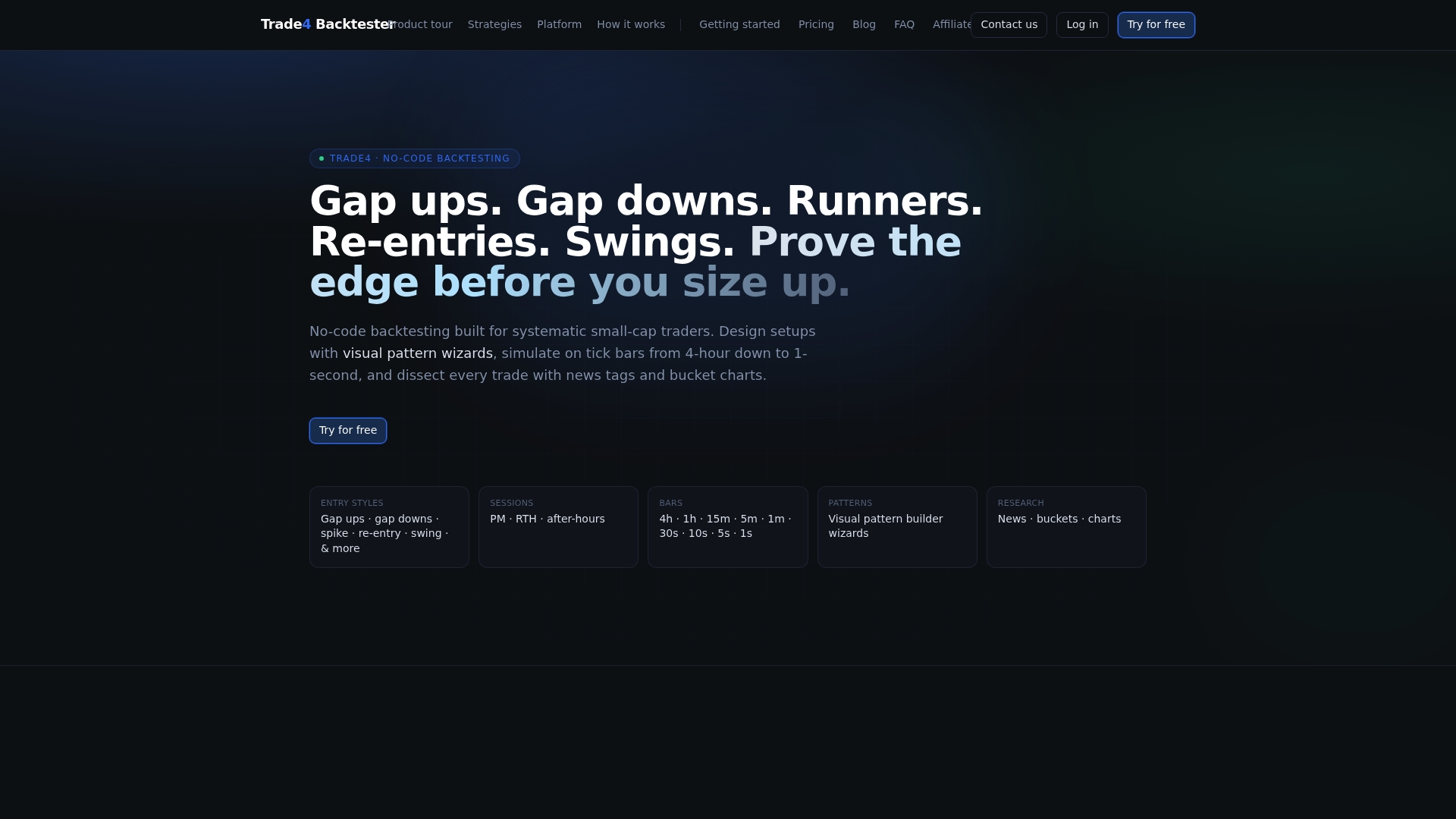
Same-day re-entry analytics and news tagging surface exactly the kind of execution nuance that separates a real edge from a lucky backtest, which is the entire theme of the sections above. If you want to see how the visual strategy builder handles your own rules, the getting-started guide walks through your first backtest in minutes, and the pricing page lays out plan tiers with no hidden step. Whatever platform you choose, paper trade the result before committing live capital. That discipline matters more than which tool you pick.